
Industry
Naike is established in the industrial vacuum cleaner industry, promoting its sustainable development and progress through various measures such as technological innovation, product research and development, meeting diverse needs, improving services and support, strengthening brand building and market expansion
Flour mills and food workshops use industrial vacuum cleaners to absorb large amounts of dust.
Flour mills and food workshops use industrial vacuum cleaners to absorb large amounts of dust.
With the country's increasing emphasis on food safety and hygiene issues, food processing enterprises are also paying more attention to factory environment requirements. How can we improve the quality of the factory production environment? Don't worry, industrial vacuum cleaners are just right for collecting waste, residues, starch powder, oil stains, sewage, and other particulate pollutants and liquids during the food processing process. They can filter and purify the air, thereby improving the quality of the production environment and production efficiency. Let's take a look at how industrial vacuum cleaners are widely used in the food industry.
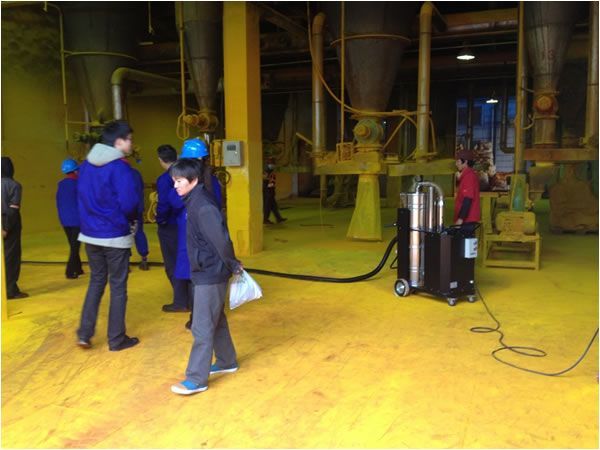
In the past, the cleaning method in flour food processing places usually involved assigning personnel to manually remove dust: stainless steel plates were installed under the production equipment to catch the leaking flour. When a certain amount of flour accumulated, workers would use shovels or other tools to scoop the flour into dedicated stainless steel or plastic barrels, which would then be taken out of the production workshop for filtering. This process of collecting flour could take several hours, consuming a lot of manpower and resources, and this traditional cleaning method could not completely avoid the possibility of flour spillage and contamination.
Now, the cleaning methods in the food industry are gradually changing. Industrial vacuum cleaners specifically designed for collecting flour in the food industry usually feature large-capacity dust collection boxes (for collecting large amounts of flour), efficient filtration systems (for filtering very fine flour), and anti-static devices (as dry flour may carry static electricity). The usage process is very simple; just use the suction hose connected to the industrial vacuum cleaner (or equipped with a suction head or nozzle) to directly suck flour from the collection board. The flour will be drawn into the dust collection box by vacuum suction, filtered and collected by the filter, and the dust collection bucket can be easily moved. It is very simple and quick, saving manpower and resources.
In summary, most consumers believe that the view that industrial vacuum cleaners are typically only used in some industrial manufacturing enterprises to collect chemical powders, metal shavings, etc., is one-sided. In fact, the application of industrial vacuum cleaners is extremely wide-ranging and is not limited to industrial enterprises; their application in the food industry is also very important and widespread.
recommend products


WeChat Public Number
Contact Information