
Industry
Naike is established in the industrial vacuum cleaner industry, promoting its sustainable development and progress through various measures such as technological innovation, product research and development, meeting diverse needs, improving services and support, strengthening brand building and market expansion
What are the requirements for selecting industrial vacuum cleaners (dust collectors) specifically for laser cutting and welding?
What are the requirements for purchasing industrial vacuum cleaners (dust collectors) specifically for laser cutting and welding?
Industrial vacuum cleaners (dust collectors) specifically for laser cutting and welding are used to collect waste, filter and purify air, and clean the environment during industrial production. Industrial vacuum cleaners can absorb various types of metal, non-metal, oil, water, and other particulate contaminants and liquids, as well as toxic and harmful gases. In the laser cutting and welding industry, they can improve product quality by removing waste gas, welding slag, and iron filings. In the chemical industry, they can recover some expensive catalysts, and as an environmentally friendly device, industrial vacuum cleaners can effectively prevent some occupational diseases, such as pneumoconiosis in welders.
The working principle of industrial vacuum cleaners specifically for laser cutting and welding: When the motor of the specialized industrial vacuum cleaner rotates, it creates a vacuum that directly sucks waste gas, welding slag, and iron filings into the dust collection bucket. The airflow moves downward, forming a series of spiral motions. The materials fall directly to the bottom of the dust collection bucket, while some fine dust is blocked by a high-efficiency filter, and then normal air is expelled through the exhaust outlet. This prevents excessive machine smoke, which can affect the working environment and quality.
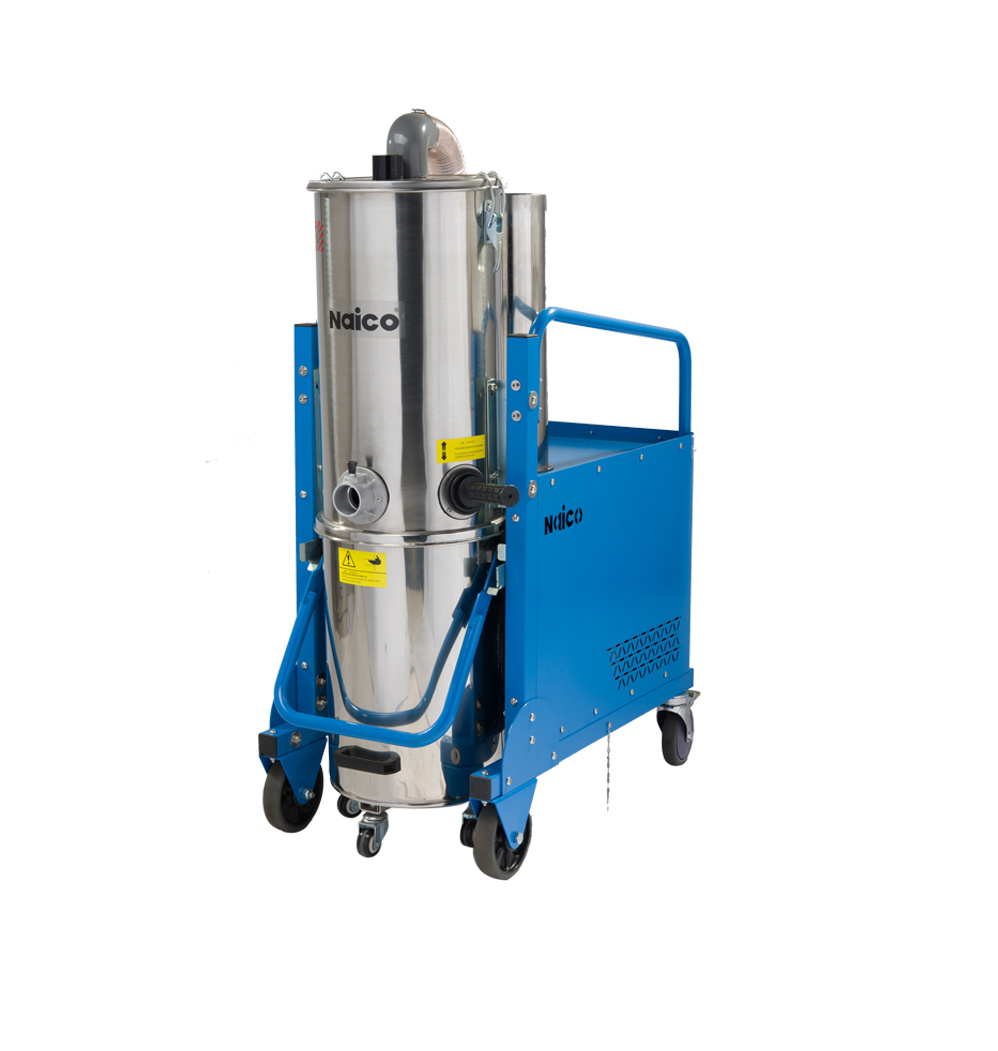
All NAIKE vacuum cleaners are general-purpose industrial vacuum cleaners (for dust and water) that are easy to operate: To ensure the vacuum cleaner lasts for more than three years, please pay attention to the following points:
1: Customers must use garbage filter bags when vacuuming (to reduce dust damage to the motor).
2: All NAIKE vacuum cleaners have aesthetically pleasing stainless steel barrels (prohibit the entry of chemical liquids, acidic cleaning agents, and other liquids that can harm stainless steel).
3: Maintenance of garbage filter bags: When the garbage filter bag reaches a certain level of dust, please remove it and clean it with the vacuum cleaner.
4. Check if the power cord and plug are damaged. After use, coil the power cord and hang it on the hook on the top cover of the machine.
5. After water absorption work is completed, check if the air inlet is blocked or has debris; otherwise, it needs to be cleaned. Check if the float is damaged.
6. Handle the machine gently; do not subject it to external impacts.
7. When cleaning the machine, please use a damp cloth with water or neutral cleaning agents. The main machine head must not be immersed in water for cleaning, and do not use corrosive cleaning agents like gasoline or thinner, as this may cause the outer shell to crack.
8. NAIKE machines are available in single-phase and three-phase models. The three-phase industrial vacuum cleaner uses a turbine motor and can operate continuously for 24 hours.
9. Long-term use of vacuum cleaners may lead to a decrease in suction power due to clogging of the filter mesh. To prevent a decrease in suction power, the filter mesh and cloth bags should be regularly cleaned with water, and after washing, they should be dried in a cool place before use to restore suction power.
10. If the main unit overheats, emits a burnt smell, or has abnormal vibrations and noises, it should be sent for repair immediately and not used forcefully.
11. Do not frequently bend the hose back and forth, and avoid excessive stretching and bending.
recommend products


WeChat Public Number
Contact Information