
Industry
Naike is established in the industrial vacuum cleaner industry, promoting its sustainable development and progress through various measures such as technological innovation, product research and development, meeting diverse needs, improving services and support, strengthening brand building and market expansion
The working principle of industrial vacuum cleaners.
Industrial vacuum cleaners create a vacuum inside the barrel through multi-stage high-pressure blowers, vortex blowers, and vortex pumps, causing the negative pressure to rise rapidly. The high negative pressure allows air to flow quickly through the intake into the barrel. The flowing air carries solid particles that need to be collected and processed into the barrel through the vacuum brush and suction pipe. The filter bag connects to the intake, where solids adhere to the inner and outer surfaces of the filter bag. The initially filtered air passes through the gaps in the filter bag and undergoes secondary filtration through the filter element, allowing the air to meet discharge standards. The filtered air then enters the exhaust duct through the exhaust outlet of the blower or pump, ultimately being discharged back into the workshop to reduce energy loss, especially thermal energy loss.
The higher the negative pressure, the stronger the suction. A wider diameter of the suction port increases the flow, which correspondingly reduces the negative pressure and suction. By selecting the appropriate type, the negative pressure can be maintained within a stable range to accommodate the intake and processing of different materials.
Industrial vacuum cleaners primarily separate solids and air through filtering media. Common industrial vacuum cleaners in the market generally have single or double filtration, such as dry and wet dual-use types with filtering materials.
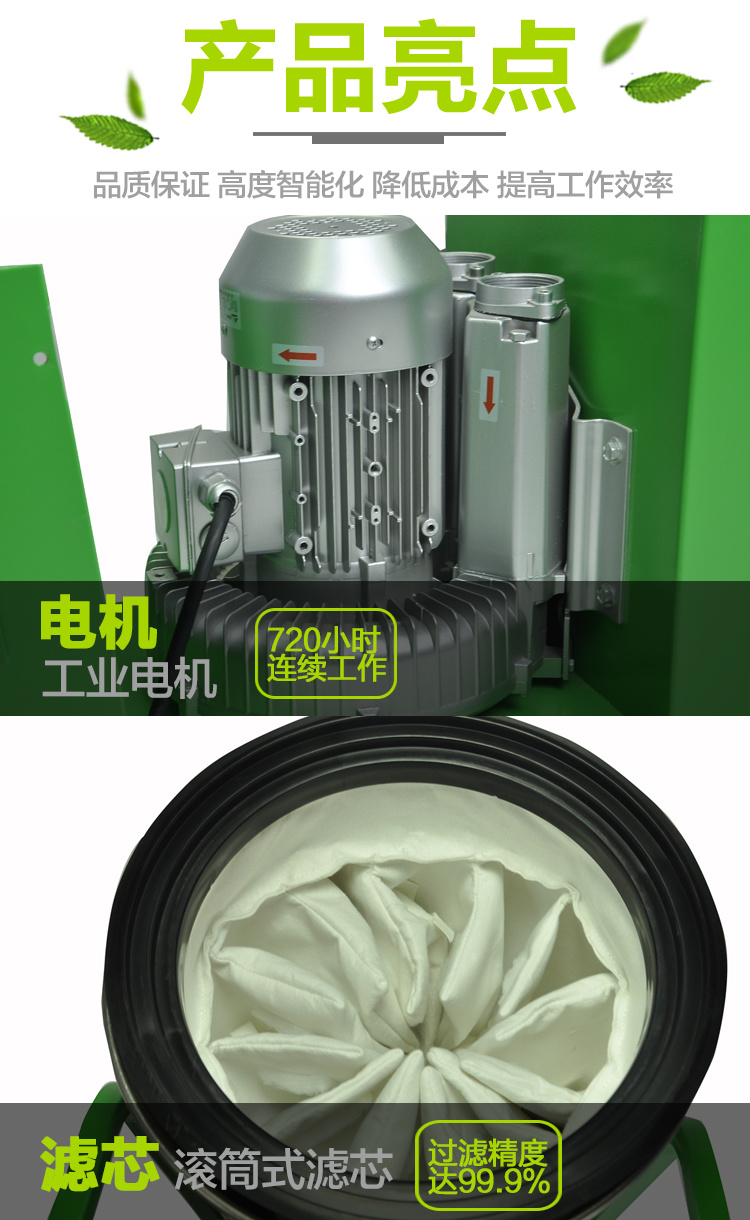
Filtering materials
The single-layer filter cartridge filtration type, dry industrial vacuum cleaners use a two-layer filtration system consisting of a filter cartridge and a filter bag. The typical filtration precision of the filter cartridge is around 10 microns, and through lamination or the use of special materials, the precision can reach below 1 micron. The filter fabric is often made of non-woven fabric or polyester needle felt, and through different manufacturing processes, the precision can be maintained at around 0.5 microns. Currently, some companies have improved the filtering media and increased the number of stages to achieve higher filtration precision and significantly enhance air purification. Nowadays, dual or more than dual filtration methods are widely used, with dry powder types using triple filtration, dual-use types using two layers of filtration, and dedicated welding fume vacuum cleaners using quadruple filtration methods. By upgrading and modifying the filtering media, such as using high-efficiency filters (HEPA), the applications of industrial vacuum cleaners can be expanded, and their effectiveness can be significantly improved.
recommend products


WeChat Public Number
Contact Information